

VERSION 2: The Ultimate Player’s Technical Breakdown
Go to the Slots Oscars page to vote for Party On Deck
**Angle:** *Mathematical mechanics, feature depth, and gameplay optimization. Target Audience: Serious gamers and enthusiasts looking to understand the “how” behind the “win.”*
For the analytical gamer, a slot machine is more than just flashing lights and catchy music—it is a complex ecosystem of probability, multipliers, and mathematical volatility. Party On Deck is a sophisticated video slot that demands more than just luck; it requires an understanding of its unique expanding mechanics and its multi-stage bonus structure. This guide provides a deep technical dive into the engine driving this luxury yacht-themed experience.
Table of Contents
- Engine Overview: The Mechanics of Party On Deck
- Deep Dive: Feature Analysis
- Technical Specifications & Data
- Optimization Guide: Maximizing Returns
- Technical FAQ
- Final Analysis
Engine Overview: The Mechanics of Party On Deck
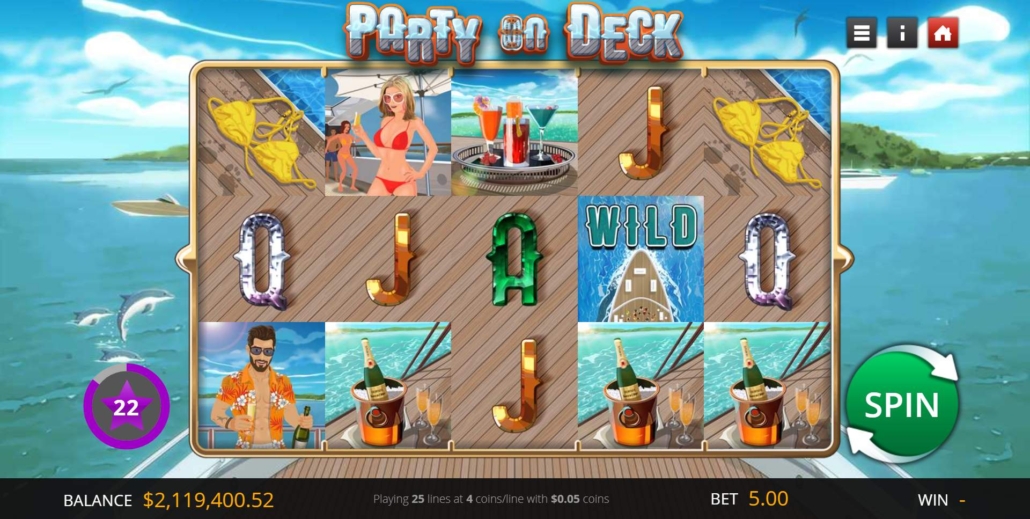
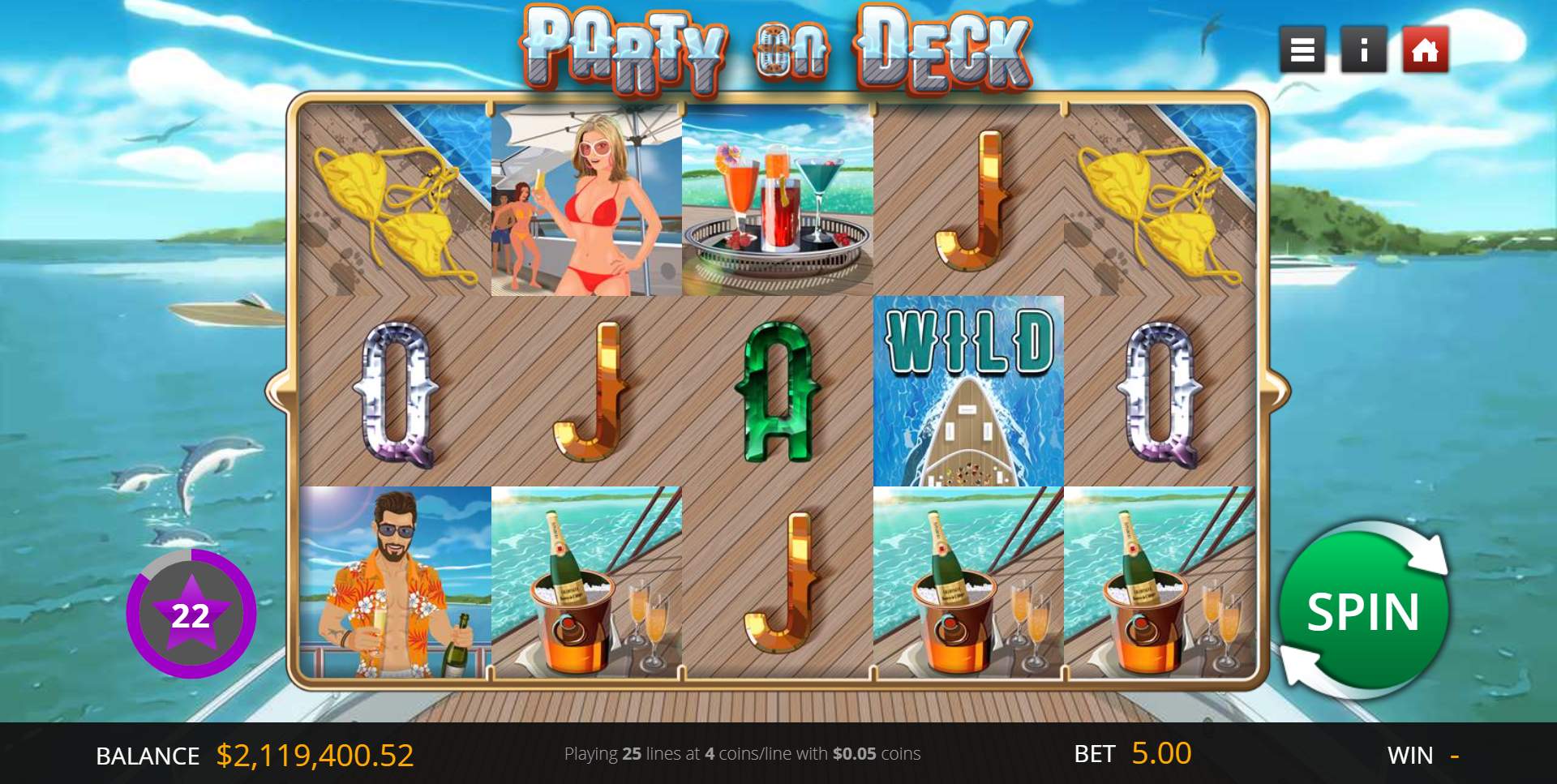
Party On Deck operates on a 5-reel, 25-line architecture. While the layout is standard, the mathematical weighting is heavily skewed toward the bonus rounds. The game utilizes a high-volatility model, meaning that while standard line wins (Aces through Kings) provide the baseline, the significant "outlier" wins are mathematically gated behind the Scatter-triggered feature. The game utilizes a 5-coin betting system, allowing for precise control over the total wager per spin.
Deep Dive: Feature Analysis
Expanding Wild Logic
The core mechanic of the base game revolves around the Yacht (Expanding Wild). Unlike traditional Wilds that occupy a single cell, the Yacht is programmed to trigger on specific reels: Reel 2 and Reel 4.
When a Yacht symbol lands on these reels, it executes an "Expand" command, filling every position from the top to the bottom of the reel. This is mathematically significant because it doesn't just create one Wild; it creates a vertical column of Wilds, maximizing the intersection points with the 25 available paylines. This significantly boosts the hit frequency of high-value symbol combinations during the base game.
The Two-Stage Bonus Sequence
The most complex element of Party On Deck is its non-linear bonus structure. Most slots offer a direct jump to Free Spins; however, this game utilizes a two-stage gateway:
- Stage 1: The Ships Wheel (The Modifier): Triggered by 3+ Scatters. This is a "pre-bonus" event. It functions as a volatility multiplier. You are not playing for spins here, but for value. The wheel determines the quality of the upcoming Free Spins by awarding either a raw quantity of spins or a multiplier (up to x10).
- Stage 2: The Free Spins (The Payoff): Once the modifier is set, the game enters the Free Spins phase (up to 29 spins). The synergy here is critical: the Expanding Wilds from the base game continue to function, but they are now amplified by the multiplier earned in Stage 1.
Technical Specifications & Data
- Symbol Hierarchy: High-value characters (Host, Girl, Helicopter) vs. Low-value card ranks (A, K, Q, J).
- Wild Limitation: Wilds substitute all symbols except the Scatter.
- Winning Directionality: Left-to-right for paylines; "Anywhere" for Scatters.
- Volatility Profile: High.
| Statistical Category | Data Point |
|---|---|
| Reel Configuration | 5 x 3 |
| Paylines | 25 |
| Max Multiplier | 10x (Free Spins) |
| Max Win Multiplier | 30,825x |
| Wild Expansion Reels | 2 and 4 |
| Max Free Spins | 29 |
Optimization Guide: Maximizing Returns
To optimize your play session, consider the following technical insights:
- The "Reel 2/4" Focus: Because the Expanding Wild is restricted to specific reels, the game's volatility is "pulsed." Expect periods of lower activity followed by sudden bursts of high-value combinations when the Yacht symbols hit the expansion reels.
- The Multiplier Priority: In the Ships Wheel, the x10 multiplier is mathematically superior to a high number of low-multiplier spins. A 10x multiplier on 5 spins is often more powerful than a 1x multiplier on 20 spins due to the way it interacts with the Expanding Wilds.
- Bankroll Scaling: Due to the high-volatility nature of the 'Ships Wheel' feature, players should adopt a "marathon" approach—setting a bankroll that allows for at least 100-150 spins to ensure they encounter the Scatter trigger.
Technical FAQ
Q: How exactly do the Expanding Wilds work?
A: When a Yacht symbol appears on Reel 2 or 4, it stretches to cover the entire vertical reel, acting as a Wild for all 25 paylines.
Q: Is the multiplier additive or multiplicative?
A: The multiplier is applied to the total payline wins during the Free Spins round, significantly amplifying the value of any combination involving the Expanding Wilds.
Q: Does the Ships Wheel appear during the Free Spins?
A: No. The Ships Wheel is a precursor event that determines the parameters of the Free Spins.
Q: What is the maximum possible win?
A: The mathematical ceiling for a single spin/session is 30,825 coins.
Q: Are all symbols part of the 25 paylines?
A: Yes, all standard symbols (Characters and Cards) are part of the payline structure, while Scatters pay independently of lines.
Final Analysis
Party On Deck is a masterclass in layered gameplay. By separating the bonus trigger into a "modifier" stage (The Ships Wheel) and a "payoff" stage (Free Spins), the developers have created a high-tension environment that rewards both patience and luck. The combination of localized Expanding Wilds and a potential 10x multiplier makes this a high-ceiling title that will appeal to any serious enthusiast of the genre.
Analyze the patterns, manage your bankroll, and prepare to launch into the most profitable party on the high seas!